
School Furniture
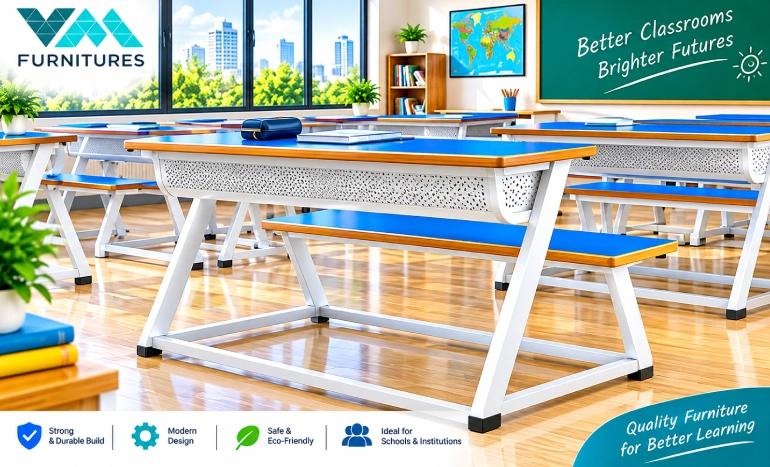
What Types of School Furniture Are Best for Classrooms, Laboratories and Learning Spaces in Hyderabad?
Choosing the right school furniture is essential for creating comfortable, organised, and functional learning environments. Schools need different furniture for classrooms, laboratories, computer labs, libraries, preschools, and activity areas. The right selection supports student comfort, classroom management, safe movement, and effective use of available space.
VM Furniture can be considered when planning furniture requirements for educational institutions in Hyderabad. Schools should evaluate furniture based on student age, room dimensions, material quality, durability, maintenance, and intended use. Whether setting up a new campus or upgrading existing facilities, a well-planned furniture arrangement helps support everyday teaching and learning activities.
Why Is It Important to Select the Correct School Furniture?
School furniture directly affects how students sit, write, read, participate in lessons, and interact with teachers. Properly sized desks and chairs can support comfortable posture, while organised storage helps maintain clean and accessible classrooms.
The right furniture also improves space utilisation by allowing schools to plan seating arrangements, walkways, teaching areas, and storage facilities. Stable construction, secure fittings, and suitable finishes help reduce avoidable safety risks during daily use.
Schools should consider the students' age groups, classroom capacity, teaching methods, accessibility requirements, and available budget before purchasing furniture. For example, a preschool needs child-sized activity furniture, whereas a high school may require individual desks, laboratory workstations, and computer tables.
What Types of Furniture Are Best for School Classrooms?
Classroom furniture should support regular lessons, writing activities, examinations, group discussions, and classroom organisation. Common options include:
- Student Desks and Chairs: Suitable for reading, writing, individual learning, and examinations. Select dimensions according to student height and classroom requirements.
- Dual Desk Benches: Useful for shared seating arrangements and efficient use of classroom space, particularly where multiple students need to sit together.
- Single-Seater Desks: Provide individual seating and make it easier to rearrange classrooms for examinations, independent work, and different teaching activities.
- Adjustable School Furniture: Can accommodate different student heights where adjustment mechanisms are appropriate, safe, and easy to operate.
- Teacher Tables and Chairs: Provide space for lesson preparation, teaching materials, attendance records, and classroom management.
- Storage Cabinets and Book Racks: Help organise textbooks, notebooks, stationery, teaching aids, and other classroom supplies.
- Activity Tables: Support collaborative projects, drawing, craft activities, and group-based learning.
Before choosing classroom furniture, schools should measure the available space, estimate student strength, and plan the number of seats required. Furniture dimensions should also allow students and teachers to move comfortably between desks and access doors without obstruction.
Materials and Build Quality
Preschool and kindergarten classrooms require furniture designed around young children's size, activities, and safety needs. Suitable options include child-sized tables, lightweight chairs, activity tables, low storage units, reading-corner furniture, and learning-station tables.
Furniture for younger children should have rounded or smoothly finished edges, stable bases, secure fittings, and easy-to-clean surfaces. Materials and finishes should be suitable for children's environments and maintained according to the manufacturer's instructions.
Low-height shelves can help children access books, toys, and learning materials more independently. Small group tables support drawing, puzzles, storytelling activities, and supervised play-based learning. Schools should select furniture with appropriate dimensions rather than simply choosing smaller versions of standard classroom desks.
What Furniture Is Required for School Laboratories?
Laboratories need specialised furniture that supports practical learning, equipment placement, organised storage, and the activities performed in each subject. The main options include:
- Science Laboratory Workbenches: Provide work surfaces for practical experiments, demonstrations, and student activities.
- Chemistry Lab Tables: Require surfaces compatible with the chemicals, cleaning methods, and laboratory procedures involved.
- Physics Laboratory Tables: Provide stable work areas for demonstrations, measuring instruments, and practical equipment.
- Biology Laboratory Workstations: Support specimen observation, microscopy, and other supervised biology activities.
- Laboratory Stools and Chairs: Offer suitable seating for students working at laboratory benches.
- Laboratory Storage Cabinets: Organise equipment, glassware, teaching materials, and approved supplies.
- Sink Units and Utility Workstations: Support washing and other activities where required by the laboratory layout.
- Specialised Safety Furniture: Chemical storage cabinets and fume cupboards may be necessary for laboratories handling particular substances or processes.
Laboratory furniture should be selected according to the subject, equipment requirements, utilities, ventilation, chemical compatibility, and applicable safety standards. Schools should consult qualified laboratory planners where specialised installations are involved. Ordinary classroom furniture may not provide the required resistance, stability, or safety features for laboratory work.
What Furniture Is Best for Computer Labs and Digital Classrooms?
Computer labs require furniture that accommodates computers, monitors, keyboards, accessories, electrical connections, and student seating. Computer desks, multi-user workstations, ergonomic chairs, instructor tables, charging configurations, cable management systems, and equipment storage units are typical options.
Desks should provide sufficient working space without crowding students. Appropriate screen placement can support comfortable viewing, while accessible electrical connections and organised cables help reduce clutter and trip hazards. Furniture layouts should also consider ventilation around equipment, maintenance access, and the location of power outlets.
For digital classrooms, schools may benefit from flexible workstations that support both individual computer use and supervised learning activities. The final arrangement should reflect the number of computers, room dimensions, student capacity, and the technology being installed.
What Furniture Is Needed for School Libraries and Reading Areas?
School libraries need furniture that supports quiet reading, independent study, book storage, and collaborative learning. Common options include bookshelves, reading tables, individual study desks, study carrels, librarian counters, book display racks, and comfortable seating.
Bookshelves should be selected according to book sizes, storage capacity, and the age of students using the library. Reading tables need adequate space for books, notebooks, and writing materials. Individual study carrels can provide focused study areas, while group tables support supervised projects and discussions.
A well-planned library layout should maintain clear walkways, accessible shelving, appropriate seating, and convenient access to frequently used books. When arranging furniture, schools should also take the needs of students with mobility requirements into account.
How Do You Choose Durable and Safe School Furniture?
When comparing school furniture, schools should assess the following factors:
- Material Quality: Steel frames, solid wood, engineered wood, laminates, and suitable plastic components offer different benefits. Select materials according to the environment, expected use, and maintenance needs.
- Construction: Check frame stability, joints, load capacity, fasteners, and resistance to everyday wear.
- Ergonomics: Match desk and chair dimensions to student age and height. Proper sizing helps students maintain comfortable sitting and working positions.
- Safety: Look for smooth edges, stable bases, secure fittings, appropriate finishes, and designs that minimise foreseeable risks.
- Maintenance: Consider whether surfaces are easy to clean and whether damaged components can be repaired or replaced.
- Space Utilisation: Measure the room and plan desks, walkways, doors, storage, and teacher access before ordering.
- Budget and Lifecycle Cost: Compare purchase cost, durability, maintenance, warranty coverage, and potential replacement expenses.
- Customisation: Check whether furniture dimensions, colours, configurations, and storage features can be adapted to the school's requirements.
No single material or design is ideal for every educational setting. For example, laboratory worktops have different requirements from preschool tables, and furniture used outdoors may need different weather-resistance features from indoor classroom furniture.
Is Custom-Made School Furniture a Good Choice for Schools in Hyderabad?
Custom-made school furniture can be useful when a school has irregular room dimensions, specialised laboratories, age-specific seating requirements, or a large campus project involving several learning spaces. Customisation may help institutions coordinate furniture dimensions, storage arrangements, colours, and classroom layouts.
Schools in Hyderabad considering customised furniture through VM Furniture or other suitable suppliers should review drawings, room measurements, material specifications, samples, installation requirements, and delivery schedules before confirming an order. For bulk procurement, written specifications and an approved sample can help maintain consistency across classrooms.
Customisation should be based on practical requirements rather than appearance alone. Schools should confirm that the proposed furniture meets the intended usage, safety needs, available space, and maintenance expectations.
How Can Schools Plan a School Furniture Budget?
A structured procurement plan helps schools estimate quantities, compare quotations, and avoid unnecessary purchases.
- List all learning spaces: Include classrooms, laboratories, computer labs, libraries, staff rooms, and activity areas.
- Estimate users: Calculate the number of students, teachers, laboratory users, and other staff who need seating or workstations.
- Measure each room: Record dimensions, door positions, windows, power outlets, and existing furniture that can be reused.
- Prepare a furniture schedule: Specify furniture type, quantity, dimensions, material, finish, and intended use.
- Compare quotations: Evaluate construction, specifications, warranty terms, delivery, installation, and after-sales support rather than comparing price alone.
- Prioritise purchases: Purchase essential furniture first and arrange additional purchases in phases when necessary.
- Inspect bulk orders: Check dimensions, stability, finishes, quantities, and compliance with approved specifications before accepting delivery.
Where Can You Find School Furniture Suppliers in Hyderabad?
Schools looking for school furniture suppliers in Hyderabad should evaluate providers according to their product range, material specifications, customisation options, production capacity, references, warranty conditions, installation services, and after-sales support.
Start by preparing a list of required classroom desks, benches, teacher tables, preschool furniture, laboratory workstations, computer desks, and library storage units. Share the list and room measurements with potential suppliers so they can recommend suitable configurations and provide comparable quotations.
Before placing a bulk order, confirm product dimensions, material details, delivery timelines, installation responsibilities, and replacement procedures for damaged items. Reviewing samples and written specifications can help institutions make informed procurement decisions.
VM Furniture is the company name to consider when enquiring about school furniture requirements. Schools should confirm the availability of the specific furniture categories, customisation options, and services they need directly with the company before finalising an order.
